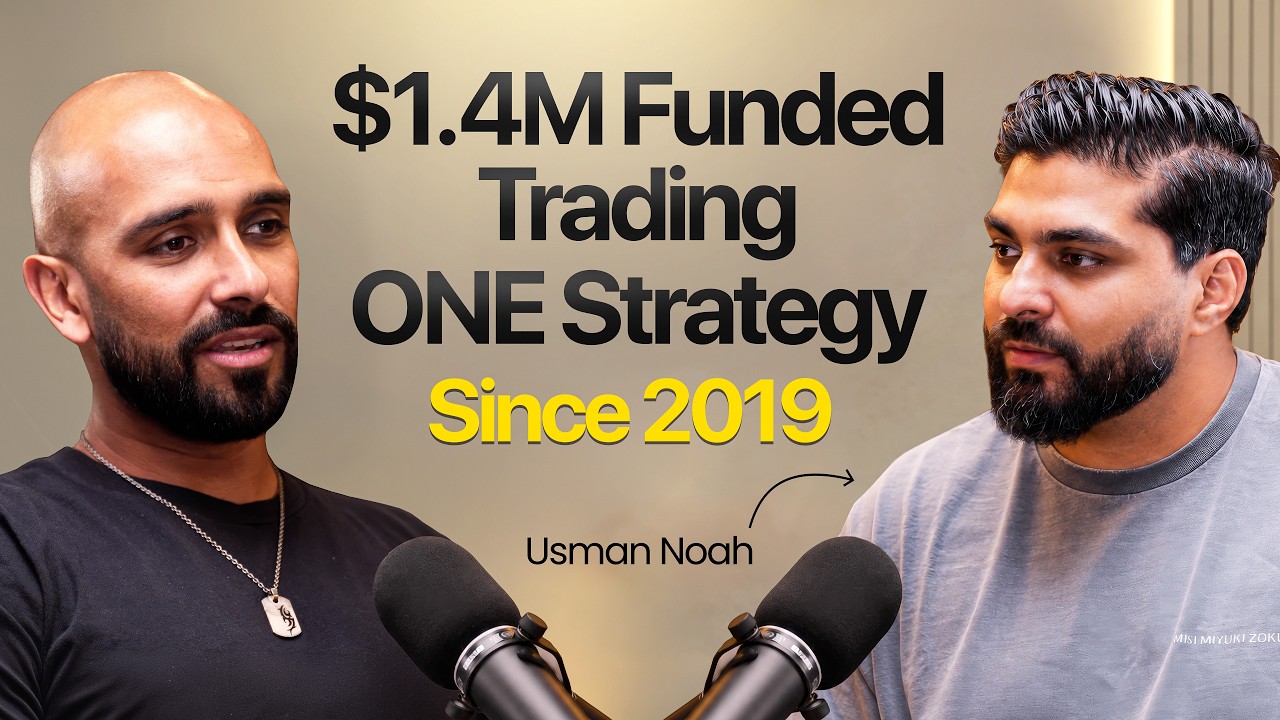
Podcast · 48 min
Razvan on the gold run behind his biggest FTMO payout
Razvan explains the two-week gold run behind his biggest FTMO payout, which the episode puts at $158,000. He says his strategy and risk did not change but market conditions did, and describes how the payout made him overconfident for about a month afterwards. He looks back on starting in 2023 and losing his first funded account in the week he got it, and talks about accepting losses, choosing a mentor, forward testing versus backtesting and staying accountable. He also covers his interest in moving from CFD to futures firms and why a payout is not the same as being profitable once challenge fees are counted.
Chapters
Guest
Razvan
Razvan is a discretionary trader who started trading in 2023, took about a year and a half to get funded and says his biggest payout, put at $158,000 in the episode, came from two weeks of trading mostly gold on FTMO. He mainly trades Nasdaq at the New York open through CFD prop accounts, usually taking five to ten trades a week at about 1% risk.
Key takeaways
- Razvan says he did not trade differently during the run. Gold was moving a lot from the Asia open in a risk-off market, so he traded a session he normally skips and caught both the run up and the run down, keeping his average risk at 1%.
- He says the payout made him overconfident. He took more trades, went into a deep drawdown and needed about a month of trading less to reset.
- Losing his first funded account in the week he got it taught him to accept that losses come whatever your strategy, risk or psychology, and to stay in the market long enough for an edge to play out. In his words, 'You just have to choose the pain that you can tolerate the most.'
- He sees backtesting as proof of concept only and prefers forward testing in live conditions, where fear and greed are real. He considers about six months of data enough to judge a strategy.
- He keeps himself accountable by sharing his trades with friends and a small group he teaches, which stops him overtrading or over-risking. He recommends finding a community that trades the same market and session.
- He aims for 3R to 5R and sets targets at structure rather than fixed multiples, then trails his stop behind 1-minute candles once the target is hit. He finds that chasing 10R or more often ends at break-even, and says a payout is not real profit if challenge fees cost more.
- He is looking at futures firms for Nasdaq, saying the lack of spreads matters on the 1-minute chart, but he dislikes consistency rules and says he blew accounts within an hour or two when he tried a trailing drawdown.
Firms in this episode
- FTMO: Razvan's biggest payout came on FTMO, where he says he averaged 1% risk per trade on a 400K maximum allocation while trading CFDs.
- Apex Trader Funding: Razvan mentions Apex while discussing futures firm rules, saying he believes it used a trailing drawdown at one point and later removed it.
Transcript
Generated from the episode's captions and lightly cleaned up, so expect the odd misheard word.
Read the full transcript
0:00Intro
0:00It was the biggest payout I have ever received. It was almost life-changing for me. I was entering more trades because I felt so confident in my strategy and my risk management where I ended up going into some deep draw down. If you want to become the best trader that you can be, you have to imagine making $158,000 in just 2 weeks. Today's guest did exactly that. And his mindset on how it was possible is probably not what you're expecting.
0:20Personally, psychology has been the biggest part. When traders say that psychology is not important and they trade purely mechanical mechanical strategies, I just don't get all that. I've tried to learn ICT concepts by myself from ICT himself. I don't believe he's a very good educator. The way he explains things, he tends to make things sound more difficult than they are in reality. Meet Rasvan. He says there's no secret strategy, no crazy risk, and no magic formula. He also shares why a huge payout like this can actually make you a worse trader for a period of time.
0:51It took me about a year and a half to get funded. Lost that account probably the same week. As soon as I got the funded account, I was thinking, "Oh, that's it. I made it. I'm going to be rich." No matter how good your strategy is, no matter how good your risk management, no matter how good your psychology is, you're still going to take losses.
1:08And what made me profitable really isn't the strategy that he was teaching me. It was it was more in this conversation, he pulls back the covers behind what made him successful. He explains why accepting losses can change everything and his opinion on the biggest mistake that traders make when they're about to scale. If you've ever wondered what separates someone who gets lucky from someone who can actually stay profitable, this is the episode for you.
1:25What do you think is the biggest lie that most traders are telling themselves? Probably that big Rh trades are what makes them profitable. That's not always the case. The answer is not as glamorous as you may think. Let's get into it. I want to jump straight into conversation
1:41What Actually Changed During His $158K Run
1:46if you don't mind. And I think the thing that most people are going to be interested in hearing about is your two week run in making $158,000 in a short space of time. Uh sounds like those too good to be true headlines that you will see online. I think when most people hear a story like that in this day and age, what they will immediately think of is there is some secret source.
2:08there's a secret strategy that has allowed you to do it and that will allow you to continue to do that inevitably going forward. Why would most traders be wrong with that idea? So, that's [clears throat] the first question that everybody asks when they hear about the payout. Um, it it does sound insane and it is insane even for seasoned traders, but the the answer is not as um as glamorous as you may think.
2:39It's not really uh I I wasn't trading any any differently to be honest from the the month prior. So what what changed was market conditions back then um in January this year. If you had longed at Asia Open, if you had long gold at Asia Open for instance, metals uh silver as well, you would have made money for the day. And it was as simp as as simple as that. gold was going on a on a crazy run and uh I just managed to capitalize on that.
3:08That's that's the answer really. I wasn't over risking. My average risk per trade with FTMO was 1%. Okay. On a on a 400k max allocation um with some trades being on 0.5 uh I believe only once or twice I have risked 1.5% and both those trades ended up break even. Okay. [clears throat] Unfortunately. Yeah. Yeah. Um, so yeah, it wasn't really a matter of over risking or I was just being more more aggressive. I normally I would say I normally enter about anything from five to 10 trades per week.
3:47Okay. And I don't trade gold as much. I trade mainly the NASDAQ. Okay. But the opportunity at the time in with metals was too good to to not look at it. M uh so yeah I guess it was just a matter of understanding the market conditions u being able to effectively implement a strategy while maintaining good risk management. So did you find during that period there was either a temptation to want to break your rules and do something differently because obviously making those returns seeing it play out at the time it it's going to have an impact on anybody's psychology right I I'm interested as to like when you say you lent into that period was there anything that you did outside of the norm that is different from your typical strategy I was trading more sessions I I never really trade the the Asian session Uh but like I said in January and I think it started in in December if you had just longed at Asia open you would have made a lot of money for the day.
4:55Um so I started looking at metals during the Asia open and um I quickly realized that you know price was actually moving a lot during during that session. Um with me only being you know only trading the NASDAQ I only look at at the New York open really. Sometimes I may enter during the London session. Okay. But price usually tends to manipulate a bit more um during the London session. How how much
5:26Trading The Right Market Conditions
5:27do market conditions play like a part of your strategy? So when the commodity sector started to go very volatile at the start of the year, was that something that catches your attention as part of what you look for in the market or was it primarily this is something that's going crazy. maybe this is something that I need to look at in terms of volatility.
5:45So market market market conditions I think should play a big role in into any strategy. Uh when I say market conditions I think about what price is doing on the higher time frames. Um obviously um the economic calendars are and uh the overall economic and political state of the world. Um so at the time the market was very risk off I believe um they were all trying to put their money into safe safe haven assets like like gold that's what gold was considered to be but gold was already very very extended.
6:22Mh. So, um I was just lucky enough. So, yeah, it has to do with luck as well. Uh as with any strategy really, I was lucky enough to capitalize on that last run up and run down. So, I got the the entire move up. Well, the for those two weeks, I caught the whole move up and the whole move down. Wow. Which was uh amazing. Yeah, it sounds like a wild ride. Um I love the part that you said there about how market conditions should be a part of everybody's strategy.
6:53And I I want to unpack this a little bit further because I think that there are going to be a ton of people that are watching this that have never asked themselves that question. So I I think the thing that would be most helpful for me and the people watching this at home is to understand how do you get to a stage or what can you do to understand what market conditions are good for you and what market conditions are bad.
7:15Right? So it really depends on on the asset as well and whether the market leans more more towards risk on or risk off. Uh risk off I would look at metals, I would look at gold, risk on I would look at indices perhaps bitcoin. Um so yeah that's that's uh in simple terms that's what I'd be looking at.
7:44The Psychology After A $158K Payout
7:44Okay. And I I want to understand how your maybe psychology or mentality changed after that period because I always say or at least the pattern that I see with a lot of traders, it's one thing to make money in this game. It's another thing to be able to keep it. And there's a lot of people that undoubtedly if they got a payout of that size, it would screw with their level of confidence, right? It would change the way that they think about certain things.
8:10It would change maybe how much risk they're willing to put on or what positions they're willing to take. Talk to me about your mentality after having such a big record payout. Do you feel like it impacted you in any way? Yes, absolutely. In a negative way. Uh so uh I I did get overconfident. I think you know it was the it was the biggest payout I have ever received. It was uh it was uh almost life-changing for me and would be life-changing for a lot of people.
8:38So I um I was I was entering more trades because I felt so confident in my strategy and my and my risk management um where I ended up going into some some deep draw down uh because of it. So it uh it has affected it. It affected my psychology. So, uh, it it took me a while, uh, to when I say a while, it probably took me, uh, a month after that of, uh, trading less and less, especially because February and March were were horrible for for indices, and that's mainly what I trade.
9:14We were consolidating on the higher time frames. Um, so yeah, this is something that I'm still I'm still trying to to improve. uh you know as as a trader I'm I'm a student of the markets. I I learn every single week. Every single week I try to to add new elements to my strategy and to my and to my psychology to more effectively uh apply my process. Yeah. If you already know you can trade, why are you still spending weeks proving it to prop firms?
9:47With Traderify, you don't actually have to. If you want to take an evaluation, their growth evaluation can be passed in as little as one trading day. But with Lightning, you can skip the evaluation completely and go straight into a funded account. Now, getting funded quickly sounds great, but none of that matters if you can't trust the firm when it's time to actually get paid. Traderify has paid out over $250 million across more than 80,000 traders, and they currently report a 0% payout denial.
10:11And if you're someone that wants to scale, allegible traders can hold up to five funded accounts with each account size up to $150,000 each. So look, if you already know you can trade, how much longer do you really need to spend proving it? Hit the link below, choose the Tradeify account that fits the way you trade and use code PFT for 40% off. Talk talk to me about that journey of psychology because it seems like it's played quite an important role in your trading, especially after that twoe runup.
10:34Obviously, you've had a recent
10:35Why Trading Psychology Matters
10:43experience with it. Um, but I know obviously a little bit from your backstory that you've had prior experiences where you've taken smaller amounts of money, flipped them into larger amounts and then given that away as well. So, talk to me a little bit about your your journey with psychology in your trading. So, uh that particular flip happened with uh with a memecoin. So, I wouldn't really interesting. Okay. I wouldn't even uh put it in the same category as this. Uh so yeah for me personally psychology has been has been the biggest part uh you know I believe when traders say that psychology is not important uh and they trade purely mechanical mechanical strategies I just I just don't get all that uh I'm a I'm a very discretionary trader okay I look at price action if the market is telling me something clear even though it goes against my my strategy I might I might answer it because if uh let's say I'm looking for a short, right?
11:40But the market is clearly displacing higher and higher at in that particular point in time. The market is not bearish at all. So if I'm looking for something, then the market proves me wrong. I'm just looking for opportunities in the in the other direction. Interesting. And with that like the journey of of being able to do that to apply that level of discretion, what psychological factors do you feel like you've struggled with most? Uh life? Well, I had to embrace all these negative emotions that that we feel.
12:24So, as traders, we we go through pain a lot. And it took me a while to understand that in trading pain is inevitable. M you've got the pain of entering too early, of um exiting too early uh or of exiting too late even. Uh there's many different pains that uh that you have to to embrace. You just have to choose the pain that you can tolerate the most. Um so I think I think that was a big a big shift for me.
13:01This is when I started to see some profitability. Of course, when the strategy and the risk management is on point as well. Yeah. Then you you add the the psychology parts to it, you will most likely uh become eventually become a profitable trader. Do how
13:21From Unprofitable To Funded Trader
13:22long did it take you to go on that journey from unprofitable to profitable? Right. So for when I first started trading um I believe it was back in 2023. Okay. Uh this is when this is when I I was first introduced to prop firms. Um at the time I had to I had to take a a year off work. Uh and everything I was doing in that in that one year was learning how to trade, studying the markets, consume as much content as possible.
13:51Okay. Back test, forward test. Uh and uh yeah, it took me it took me about a year and a half to to get funded. Okay. Got funded uh in 2024. Lost that account probably the same week really with within Yeah. cuz I I was so greedy at the time. Uh as soon as I got the the funded account, I was thinking, "Oh, that's it. I made it." Yeah. I'm going to be rich.
14:23M that I think that's what that's what we all go through as traders. Uh reality is a bit different as we all know. Um so yeah, losing that account uh was uh was painful but it was a pain that I needed. That was a that was the first funded account I lost. Of course, you know, I've been I' I've blown through so many accounts in the in the process of learning and really applying and finding my edge in the market.
14:54Um, I believe we all go through that, of course. So, on the topic of acquiring that funding, the first one, and then losing it basically within the same week, I have
15:02Losing His First Funded Account
15:07a couple of things that I want to unpack from this because I know there's going to be a ton of people watching that can resonate with a story like that. Sure. Firstly, how do you bounce back from that? Because obviously getting funded and reaching such a milestone as part of your prop trading career is going to be something as you said that most people want. But when you somewhat achieve it and then give it away so quickly, how do you flip that mentally to be able to take it as as a lesson as something that you needed to experience to to go on to find new levels?
15:34It's accepting that pain, right? uh we we just have to to really embrace the fact that at no point we have control over the market. At no point we know uh what participants are currently entering or exiting the market and whether they can drive the the price. So accepting the fact that no matter how good your strategy is, no matter how good your risk management, no matter how good your psychology is, you're still going to take losses.
16:02Even seasoned trader are still uh are still struggling with that. They they're struggling with psychology themselves. They struggling with the strategy themselves. I don't believe there's there's a perfect strategy that achieves consistently the same risk-to-reward ratio, the same win rate. Um that's why I don't really believe in in mechanical strategies. I believe that as traders, if you want to become the best traders uh the best trader uh that you can be, you have to analyze the market and understand the context you're in.
16:39understand the bigger picture. Uh clearly see what price is telling you in that specific moment and what session you're in, what time of the day you're in, uh where you are in that structural point. Interesting. I like this. And I I think the the second part that I wanted to unpack was of course bouncing back from that period is is important for everyone because they're going to go through that phase where they blow a funded account at some point in time.
17:10The the other interesting aspect um I want to know from your side is what was the lesson that you took from that like going forward and for any other account that you have or or challenge that you have ever taken what has to change mentally to stop you making that same mistake again? So yeah once again is acceptance accepting the fact that you have no control over the market. So you just have to uh be in the market long enough to allow your your edge to eventually play out.
17:50That's that's what it was. Do you do you think that's easier with a little bit of experience? Because I think that there's a lot of people that will hear this and they will think it sounds easy, you know, just to say in words, but in the moment when you've lost that account, when you're feeling that pain, when you're feeling frustrated with the markets, is there something specifically that you would do now that you didn't do back then to help you to accept that and make peace with it to be able to move forward?
18:18So I I now got to a point where I I just accept and embrace losses. Another big factor that helped me um in reality was the fact that um I because of my my history with with crypto which we haven't talked about yet. Um you know I've made quite a bit of money with crypto. So I had substantial um access to capital to my own capital. Okay. So I can uh so I can, you know, pay for my my mentorships and my accounts and all my uh all the all the tools that I need to help me succeed.
18:58I understand that not not a lot of people have the same process. They don't have the same circumstances. Uh and I I was lucky. I was lucky. I was also lucky about the fact that I I had to stay away from work for a year. And uh I had all the time free to study at the time um you know I was studying from 7:00 a.m. until about midnight every single day.
19:29It has ruined some relationships really. Uh well yeah but you know my partner stuck stuck around so u uh very glad for that. Yeah. Yeah. They they always say though um luck is a combination of preparation and and opportunity coming together. Right. if you didn't maybe put in all of those hours at the time, if you weren't prepared and didn't have that, you know, break and time away from work, maybe it wouldn't have panned out the way that it did. Um, so I think it's uh an interesting way to look at it, but you've touched on something there which
20:03The Sacrifices Behind Becoming Profitable
20:05I think is actually very relatable for a lot of people. Relationships. When it comes to trading, I I'll tell you a little bit from my experience. I have found that not a lot of people can understand the journey of what trading can be like. The ups and downs, the highs and lows that you go through and actually if you don't create an environment that is that provides some support, trading could be quite a lonely journey.
20:32It is maybe the right way to put it. What's been your experience with that? Cuz clearly you said you've been through that period where you've had that obsessive phase. you've spent countless hours on the charts and you said it's had an impact on your relationships. How have you dealt with that throughout your experience and like what can people learn about how to manage that going forward? Okay. So, an advice that I could give is um do not uh do not forget about your partner in this process about your your friends.
20:57they they are still important and especially if you have friends uh that you can learn this with that's very valuable because you can hold hold each other accountable. Uh that's another thing I want to touch on when you first learn to to trade it's vital to find the right kind of information. Um, so there there's so much information out there. If you try to learn on your own just by consuming YouTube content, you're gonna find so many strategies, so many theories and uh so many elements that really contradict themselves.
21:40So it's very important to find the right mentor. I was lucky enough to find to find very good mentors. especially one of them has really changed the way I look at the market and what made me profitable really isn't the strategy that he was teaching me. It was it was more how he was looking at the market, how his uh mentality, how his psychology was before and after before, during and after entering those trades. Could you tell us a little bit about like the biggest lessons that you learned from that?
22:18cuz I I think specifically like the the psychological elements that you said you observed in him that clearly you have tried to to mirror or create for yourself in some way. Um what what could we learn from that experience? I will probably just going to have to repeat myself in here again cuz the the big the biggest part for me was again accepting that at no point uh we have control over the market. So if I enter a trade, I don't, you know, all I do is stacking up confluences, you know, trying to bring the odds in my favor.
22:55So if I get so many confluences that tell me that tell me one thing, I'm willing to put some risk on the table. Okay. Um, I keep forgetting that question. I can take a crypto trade at 2:00 a.m. on a Sunday and my prop firm doesn't even care. Bitcoin doesn't close at 5:00 p.m. It doesn't take weekends, and neither does Tradeify 247. Tradeify 247 gives you access to over a 100 crypto pairs 24/7. But this is the part that I wasn't really expecting. It's not just crypto.
23:25You can even trade tokenized stocks like Nvidia, Tesla, and Apple 24/7, even on the weekends. And with Tradeify 247, you can hold positions overnight and through the weekend without swap or overnight holding fees. And if you're sitting there thinking, "Great, but I don't want to spend weeks trying to get funded first." Then don't. They also have an instant funding option, so you can skip the evaluation and start trading a funded account immediately.
23:46So, next weekend, when the setup that you've been waiting for finally appears, do you want to be trading it, or do you want to be sitting there wishing that you could? If you don't want your prop firm deciding when you should trade, hit the link below. Choose the account that fits the way you trade and use code PFT for 40% off exclusively for PFT viewers. We were talking about what lessons like the psychological lessons that you would learn from your mentor at the time and what we could take away from that because you said you you admired his his psychology, his demeanor.
24:19You learned a lot from that. What were the things specifically that you you learned to and how you applied them? Uh right. So I believe the guy is is a freak in all honesty. I love I I I just love the analogies that that he uses when he explain when he tries to explain uh complicated concepts especially for a beginner. Uh he was trying to bring this idea into simple terms into day-to-day terms.
24:44One one other thing you touched on there was you mentioned that having
24:47Finding The Right Trading Education
24:51the right information was very important and I I completely agree with that but I think it's also quite difficult. We live in a day and age where we have basically access to unlimited amounts of information. How do you figure out which is the right and the good information and separate that from the bad one? Right. So for me um what uh what I have learned in the beginning was um was a I would say a simplified version of ICT concepts.
25:18Okay. Um so um when I um when I joined um my u my mentorship uh you know it's not necessarily um a cheap mentorship okay but this is this is where you will find the high value people. Uh this is where you will find that the the people you trade on a daily basis, the the other members in the community, they are all highly skilled or are successful have already been successful in their lives in order to you know afford that mentorship.
25:48Yeah. And it it's it's um it's a it's more of a personal feeling because there's so many communities out there that can can help and you can take away from. But sometimes it's hard to even like you were saying to to select what information you need. M uh this is where um you know joining um a community and find finding a community and uh the right mentor that will really guide you and give you the exact information is uh is very important.
26:20So what gave you the confidence to believe that that was the right mentorship for you especially if it was relatively high ticket? Was there something about that group or community or the the information that was presented that sold you on the idea that this could be the the missing piece that I need to my trading? So, I've tried to learn ICT concepts uh by myself, okay, from ICT himself by watching his uh his videos. Uh but um he's not I I don't believe he's a very good educator.
26:49Okay. the the way he explains things, he he tends to make things sound more difficult than they are in reality. Uh I believe that's part of his marketing, but that's that's a whole different discussion. Fair. Uh so Jesse Rogers, which is um most which is known as Casper SMC. Mhm. Uh he he simplified this concept and really uh really broke down every single aspect of it. Uh there's no way that you know as ICT traders, there's no way that you'll be able to to look at every single theory that he put out there.
27:29Uh I don't think there's any ICT trade trader that trades every single thing that ICT himself has spoken about. you kind of just select the the concepts that more resonate with you. Yeah. And then you you kind of translate that, interpret that and build your own strategy from that. That's that's how I see ICT. So when when you were looking at that mentorship, they presented something which seemed like a more simplified version that you resonated with.
28:03Yes, that's correct. Yeah, that's the right way to look at it. Yeah. And once you have that right information, something else that you touched
28:07Backtesting vs Forward Testing
28:12on was your back testing. Um, how much emphasis and importance do you put on back testing? And I asked this primarily because we've had some guests that say it's absolutely everything and then some guests that will tell you it's a complete waste of time. Okay. So, where where do you kind of sit with this? Do you believe that people should be doing it or do you believe it doesn't really have value for everyone?
28:32Okay. So, I might get some hate for for this. Go ahead. Um so I I do believe that it's important but only as proof of concept really okay um so you know it's important to test your strategy go back in time and you know have candles uh you know print in a certain way um which is not really how live markets work and the the the main thing is that during back testing you won't you won't really feel those those emotions you won't uh you won't be susceptible to um to pain to fear to greed to FOMO you won't feel none of these emotions so it is important but I would much rather forward test and try my strategy in in a live environment and over whether you're back testing or forward testing what sample size of data should we be focusing on before we determine that something either works or doesn't work I believe um 6 months is good enough.
29:37Okay. Uh I I know traders that have three, four, five years of back testing data. Again, not to say that is not useful. Mhm. It would waste too much of my time. I would much rather try out my strategy in a live environment. So, and I guess with the the element of discretion that you add, I guess the back testing may be somewhat skewed.
30:00Is that the right way? Yes, correct. Especially that I like to see how candles are printing. I like to see how candles reach a certain key level is that like you will be able to see displacement let's say through a level uh when you back test but it's just not the same cuz the when you see when you see uh the candle let's say reach um your previous day high if it displaces through it you'll be able to see how that particular candle is printing and especially uh if I trade the than one minute at New York open.
30:34Okay. I don't think Trading View allows you to go that, you know, back in time too much to to get that uh to get that data. Um, so yeah, once again, I believe it is important, but I would much rather feel and embrace those emotions in a in a live environment. And how how do you deal with the emotions on a day-to-day
31:01Staying Disciplined & Accountable
31:05basis? Right. We've talked about obviously we've touched on the record payout um and and the impact that that had on your psychology, but on a day-to-day basis, are there certain things that you're doing or focusing on that allow you to remain consistent with your process? Uh so, one of the biggest thing that has recently helped me is um sharing my uh my trades with all my friends uh and the little u and the little community of uh people that I'm I'm teaching. Okay.
31:35Uh so I I'm not really allowed to make mistakes anymore. Uh because they will hold me they will hold me accountable and especially if I want to reinforce this uh responsible behavior. I I I cannot I cannot overtrade. I cannot over risk. I can't I I will only have to enter trades uh that I truly believe in or trades with asymmetrical risk where the where my stop loss could be very tight and the potential uh reward could be very high.
32:05So you've kind of put yourself in a position where accountability is enforced and you you've put it on yourself, right? I because I've always said that some of the hardest parts of trading is we have so many different roles that we have to play, right? We have to we have to be the analyst coming up with ideas. We have to be the trader, the one that actually pushes the button, but then we also have to be the risk manager.
32:29And sometimes all of those roles, they don't necessarily agree with each other. And the fact that we have to play all of those roles ourself as a single person is quite difficult. And so there can be some benefits behind having a community, a group of people, an accountability partner, uh something to to kind of help you along that path. What advice would you give to people that are trying to do this alone?
32:55Do you think it's beneficial for everyone to have some form of accountability? So yeah, it is important to find a community of people, a community of like-minded people that trade the especially if they trade the same assets as as you do. So let's say you have a community of people that only trade uh NASDAQ at New York Open. Then you will both exchange trade ideas. You will uh both share your your entries, your exits, uh what strategies you have used uh and what was your your your criteria, your checklist and what what got you there.
33:30So it's uh it's very important yeah to have a community to have uh to have someone holding you accountable. Nice. And uh since the
33:38Moving From CFDs To Futures
33:41the payout with FTMO, is there a longerterm plan on how you want to manage your prop trading? I know when we spoke before, you mentioned that there was a thought process to maybe start working in the future space as well. Yeah, that's correct. Um especially because I trade NASDAQ at the open. That's just that would be perfect for for futures. Um it's not the only thing I trade. I also trade gold and like like I was saying that's where most of my uh my trades during that two week cycle uh have happened but yeah I'm looking at I'm looking at the futures firm and coming from CFDs you know the whole risk management and execution is a bit different so I'm uh I'm still in the process of learning all that uh I mean it's not it's not very complicated that's not what I'm saying here uh I'm saying that I I like to be a master of everything I do.
34:30I like to go very ind depth with my with my risk management. So, um there's so many different rules between CFD prop firms and uh futures prop firms. Uh something that I I hate really is uh the consistency rule. U then uh I believe uh there's no more um trailing draw down with no firms. I'm not sure if that's correct. I know that Apex was doing that at some point uh and they removed it. But yeah, I've tried trading with trailing draw down at some point and I think I blew all accounts within an hour or two.
35:12You just can't allow price to move too much. If it goes in your direction and then it retraces just a little bit, a tiny bit really. Yeah. Yeah. You you're out. Yeah. Yeah. So are you you're finding you're having to adapt your approach? I definitely have to have to adapt. Uh yes. Uh it's not always uh an easy process. This is where you're kind of trying to rebuild yourself as a trader. Like I said, I was I had some uh uh bad experiences with CFD firms in the in the recent past.
35:46Mhm. Um so I I know there a similar things happen in the in the futures firms but uh the there's so much there's so much choice and uh the the pure fact of trading you know futures and as you know assets that uh don't have any spreads it's uh it will be very important especially if you trade the one minute. Yeah.
36:20And things like slippage and things like this. All very important that you know you won't experience that in the future side of things as well, especially on the lower time frames. Yeah. Yeah. For sure. For sure. Um [clears throat] I I want to I want to cycle back a little bit. One
36:33How Crypto Funded His Trading Journey
36:37thing you mentioned a little bit earlier on which I think is actually a really interesting point is your background in crypto. Okay. and how you had some early success in that area which actually gave you this almost pot of money which allowed you to remain somewhat detached from what you were doing in trading. Is that a fair way to put it? Yeah, that's correct. Yeah. Um, talk to me about your that starting ground in crypto and do you feel like any of what you learned in the crypto space has helped you uh succeed in in the prop firm space?
37:03So yeah, starting in crypto helped me understand the bigger picture, helped me understand the fundamentals. Um, knowing what an economic calendar is. Um, so yeah, I started with crypto in 20 2016, but it wasn't really about trading. It was more about understanding uh and learning everything I could about blockchain technology. Um, I I believed at the time that Bitcoin and Ethereum would eventually replace fiat currency. I no longer believe that. What What got you to change your mind on that? I'm not too sure.
37:45It's um it's this feeling that we're really I might be wrong, but we're really not going in that direction anymore. Okay. Um cuz the whole the whole idea of crypto I believe at the time was uh you know us against them. It was uh it was all about uh not allowing governments to to print money and to just you know Yeah. Uh right. So going back to how uh crypto set you up for success in prop firms like what it taught you and things like this.
38:21So yeah, so the way crypto helped me also is um you know at the time I was I was investing rather than rather than trading. It I missed the the bull run in 2017 I believe it was. So uh my my plan was uh No, I'm talking about the 2021 bull run, right? So I missed the 20 2021 bull run. Okay. Uh I missed most of it. I got to it quite late.
38:55Okay. Uh so my plan for the next for the next few years were to just accumulate weekly, monthly as many um high quality coins as um as possible. So it it worked out pretty well. I ended up uh uh doing well over six figures from that. Uh so this is this is what like I was saying, this is what helped me in in that gap year I had to take off. Yeah. Uh maybe that's one of the reason I have this detachment from money.
39:24I don't really look at look at the money until it actually hits my bank account. It's all screen. It's all numbers on on a screen, right? So that experience initially started with crypto. Yes. That's how that's how it all started. Got you.
39:39Payouts vs Real Profitability
39:39And and you mentioned that obviously you've had to work on your relationship with money overall. Talk to me about what that journey's been like for you. So I I believe I still have a detachment from you know to from money but uh that's not always uh beneficial uh because it's very important you know to to make money in the market but how much of that money can you actually keep so it's all about how much are you paying in let's say in the in the prop space how much are you paying paying in challenges if you're getting a 2k payout but then you're paying 5k in challenges you're not really profitable are you even even though you're getting a payout out.
40:15You might tell yourself that, but you're not. Very true. Very true. Um I I want to uh start to wind things down slowly. I have a
40:19Quickfire Questions
40:26uh a couple of segments that I like to do towards the end of every episode. Uh one of them is just some quickfire questions, some hot takes, um where you pick one side or the other. The second side is we like to call confessions of a trader. Okay? and I will explain as we uh as we get onto that side. So, starting off with some quickfire. Um would you rather trade prop firms or personal capital? At the moment, prop firms.
40:56Nice. Uh do you prefer crypto or equities? NASDAQ. Oh, crypto broke my heart. So, uh NASDAQ currently. Fair enough. Um would you would you suggest people trade alone or as part of a mentorship? Oh definitely as part of a mentorship if you can if you can afford it join uh a high ticket membership uh mentorship uh as you will most likely learn substantial amount of useful information.
41:26Interesting. That's a that's an interesting take because there'll be a lot of people that will they hate on the idea of high ticket mentoring. I mean it obviously depends it depends on who the mentor is. Uh, and like I said, I was lucky enough to to find a fantastic mentor. Fair. Fair enough. Um, if you had to pick one or the other, would you only ever trade NASDAQ or gold? Gold. Purely because of the volatility injection on at 9:30. Nice. Uh, do you think NASDAQ?
41:56I'm sorry. Did I say gold? Yeah, you said no. So, so NASDAQ. Yeah, because NASDAQ before because of the volatility injection. Got you. What do you think is the biggest lie that
42:04The Biggest Lie Traders Tell Themselves
42:07most traders are telling themselves? Probably that that big uh trades are is is what makes them profitable. That's not always the case. In in fact, in most in most cases, that's uh that's not really the reality. Interesting. I like that. Tell me, what do you mean by that? So, I try to aim for a for a three to five R if I if I if if I could if I can. Uh then again, I'm not it's easy because I'm not saying it's easy to trade.
42:38I'm not saying it's easy to get these wins and these art. It's easy because if you trade only one particular asset at one particular time, which is the first hour and a half of the let's say of the New York session, uh you're likely to to find some sort of opportunity on the on the lower time frame once a key level has been hit. Okay. Um so when when you aim for those two to three Rs perhaps even one even though I a one hour for for me I would consider that almost a break even.
43:12Okay. Uh but if you aim for those five to you know 10 20 hours price will most likely retrace and tap you out because at some point you're going to have to go break even right? So if you aim for a let's say you go break even after two R it's very very likely that price will retrace and tap you out. Interesting and you end up with uh no profits at all. It happened to me so many times. Sounds like a bit of pain that you had to experience there.
43:49Of course. Yeah. However, if just expanding on that a bit, if um it's also important to let trades uh run as long as possible also only if the context allows it. So I never aim for for fixed hours. So I always try to look at structures at what low or what high can uh can we hit? That would be my target. Once we hit that target, I like to to tra aggressively trail my uh my stop loss on the on the one minute not structure on the one minute candles.
44:27Okay. So, uh yes, this is something that my my mentor calls price waiting I believe. So, it gives you an opportunity to potentially ride more if to squeeze as much as possible from from that from that move. Gotcha. And sometimes it will really help you know sometimes uh you will you will get a little less but overall over the long term uh just that little change in your risk management will have a very big impact on your trading. I like that. So last
44:58Confessions Of A Trader
45:00segment of the day is what we call confessions of a trader. So, this is where I compile a list of conversations and experiences that I've had with traders into a confession and I read them out for our guest. And I want you to think of this as an aspiring trader is confessing their issues, their struggles, their battles to you.
45:20And I want you to be able to give your honest thoughts, advice, and wisdom to help them to overcome this. Okay. So today's confession of a trader. [snorts] Uh this person says, "I've spent years learning strategies, jumping from one to another, but I still don't trust myself to execute them. How do I know whether I have a strategy problem or a psychology problem?" You might have both. You might have both. Uh if you don't know that your strategy is profitable, it's probably because you haven't back tested and forward tested enough.
45:48And uh touching on the psychology bit, how do we know that you are effectively implementing and executing that strategy? So yeah, it all comes down to to look at looking at that person and uh perhaps it goes beyond strategy and psychology perhaps is the the environment they're in. M the fact that if your environment is not in place, let's say you know you have issues at home or financial problems that can affect your psychology. Definitely some interesting areas to be thinking about and looking at for some people there.
46:29I like that. Um [snorts] Razan that is uh a wrap I think for today's episode. Thank you so much for your time, your experience, your wisdom. It's been super interesting hearing about your story and I'm sure there's going to be a lot to take away for the viewers at home. I appreciate it. Thanks for having me. Thank you. Right, guys and girls, that is a wrap on another episode. What was your biggest takeaway from today?
46:54Was there something that was said that sparked a perspective shift? Something that will allow you to change your approach, refine your edge in some way, shape, or form. Let us know down below. Put it down in the comments, and we'll be reading every single one. If you're someone that wants to have your confession read out to a future guest, take a look at the description box below. There will be a form for you to submit your confession of a trader so that we can help you on your journey going forward.
47:20As always, if you enjoyed this video, be sure to like it, subscribe to the channel for more episodes like this, and we will see you in the next one. Take care. Welcome to the Propirm Trader YouTube channel, the number one channel in the world for funded traders. The best way to continue to support us is make sure that you're subscribed to the channel and you like this video. That's going to help us to continue to reach the best prop firm traders and best prop firms in the game.
47:44As well as this, we also have a free Discord through Chart Fanatics where we deliver endless amounts of education and value completely for free. On top of this, we have in-depth strategy breakdowns on the Chart fanatics YouTube channel. And of course, we have professional trader interviews on the Words of Wisdom channel. And last but not least, we have completely free trading education which is going to completely revolutionalize the space on Chart